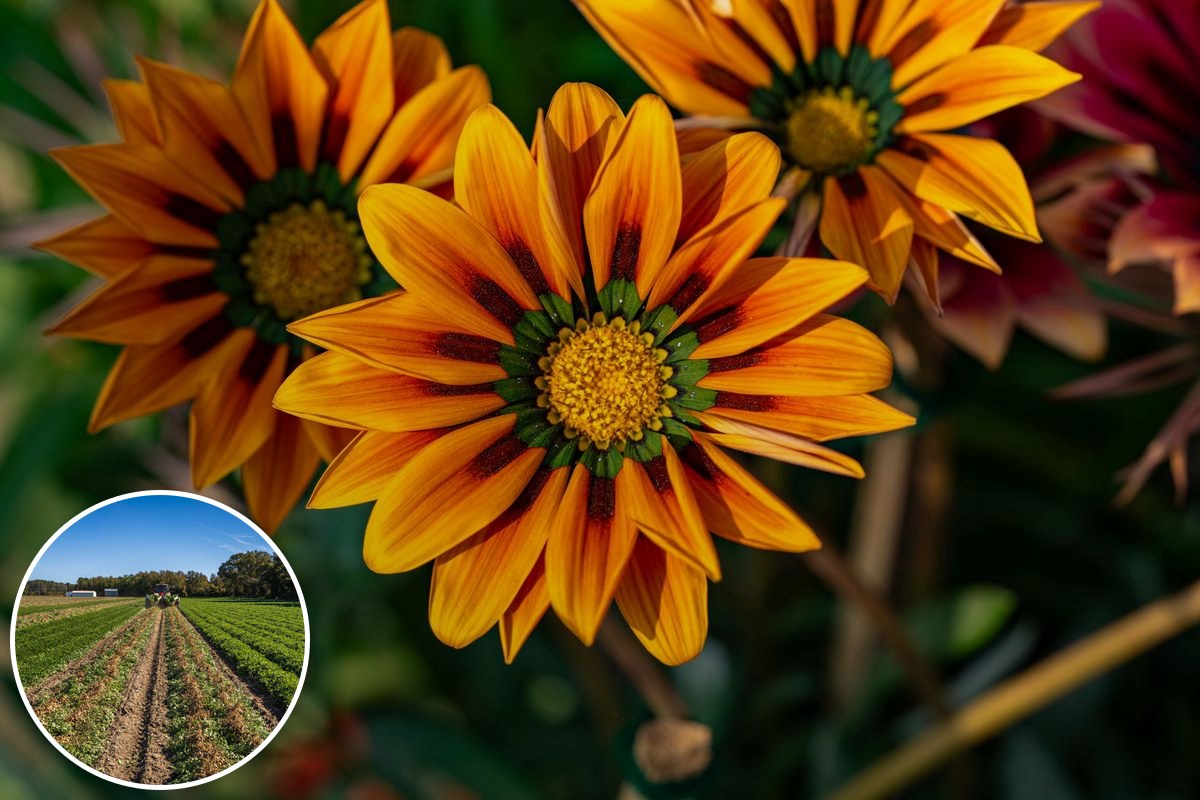
One of the best cropping seasons on record has come with an unwelcome passenger. The extra rainfall that has filled South Australian paddocks this year has also helped spread gazanias — the bright, daisy-like ornamental introduced from South Africa in the 1950s and 1970s that is now a declared weed in South Australia, Victoria, New South Wales, Tasmania and Queensland. As ABC Rural reports, trials on farms at Loxton in the Riverland and Arno Bay on the Eyre Peninsula are finally showing what it takes to kill them.
"Despite being so beautiful, [gazanias] cost us daily in terms of economic yield losses in grain production systems," said project lead Ali Bajwa, whose La Trobe University team is running the research. "[They] are also spreading into some desirable native ecosystems where we have some species that are high value from [a] conservation point of view." The Grains Research and Development Corporation has put $700,000 into the three-year project, after earlier work revealed how far the weed had spread across southern Australia and into parts of Western Australia.
The best results so far combine cultivation — machinery ripping deep into the soil to pull the weeds out — with herbicide mixtures, and some farmers are adding video-sensor spray technology. Dr Bajwa says the combination is wiping out up to 95 per cent of gazanias in trial paddocks. "While cultivation is not desirable in these soil types and the sort of erosion risk or other environmental factors that can come with that, if we use it strategically once in a while that can potentially be a good option," he said. There is still no registered product for gazanias — farmers fight them with herbicide mixtures — but Dr Bajwa is hopeful: "We're getting some very good results and hopefully within [the] next year or two we could be potentially seeing some minor use permits or potential registrations for this particular weed."
For Loxton farmer Paul Rudiger, the stakes are painted across his paddocks: some have been rendered unviable for cropping, a blow in a great season after years of drought. "The crop, the cereal we sow around them will actually die because with their [the gazanias'] root system they take all the moisture," he said. His machinery has had to rip up to 250 millimetres into the soil to tear out the tap roots — intensive and expensive, but it is letting crop grow again. "It's a cost and something that we would rather not do but because we can kill a gazania I'm happy to see a dead gazania."
Up the road, Paul Kaesler is using the same cultivation-and-spray combination on the farm his family has worked for more than a century, after gazanias spread in from nearby irrigation blocks along the road verges. He is pleased with the trial results — and impatient with the approvals pipeline. "I think that needs to speed up in some way or another or else they will be across the whole state before everyone knows," he said.
In the meantime, both farmers' fight keeps being restocked from the suburbs. Gazanias are sold as seeds and plants interstate, and only sterile varieties may be sold within South Australia — restrictions Mr Kaesler says the public needs to respect. "We still have people come through and go, 'Oh, I'm going to put them in my garden,'" he said. "Yes, they look pretty and wonderful but they're more of a pest than they are a prettiness."